
Standardize or adapt? The answer is rarely absolute
The debate is not new. Theodore Levitt famously argued in Harvard Business Review that increasingly global markets created opportunities for companies to standardize products and benefit from scale and consistency.
Later research offered a more nuanced conclusion. An analysis of 36 empirical studies by Theodosiou and Leonidou found that there is no universally superior choice between standardization and adaptation; the appropriate approach depends on the circumstances of the particular foreign market.
For food manufacturers, this suggests a practical principle: adapt selectively rather than automatically.
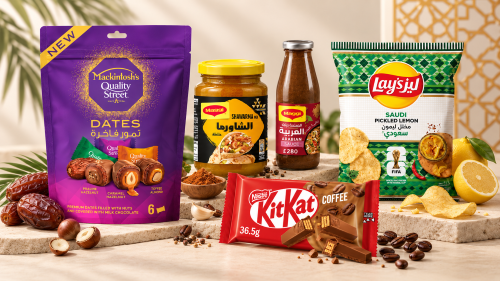
GCC markets provide several examples of global brands doing exactly that.
KitKat preserved its identity and adapted the flavour
In 2020, Nestlé introduced KitKat Arabic Coffee for Ramadan. The product combined the familiar KitKat format with roasted Arabica coffee and cardamom, drawing directly on the regional importance of Arabic coffee.
Nestlé said the launch responded to local consumer demand and initially made the product available across Saudi Arabia, the UAE, Kuwait, Oman and Bahrain, as well as Jordan.
The interesting point is what did not change. KitKat did not abandon its global identity. Instead, a locally relevant flavour and consumption occasion were added to an already recognizable proposition.
Quality Street reimagined a familiar regional product
Nestlé took the idea further with Quality Street DATES, launched in 2021.
Quality Street described it as its first product in almost five years designed specifically for consumers in the Middle East and North Africa. The product combined dates with chocolate, nuts, caramel and other elements associated with the Quality Street range, and was launched initially in the UAE, Saudi Arabia and Kuwait.
Again, the strategy was not to make the global brand disappear. The strategy built on an established brand to offer a new interpretation of a product familiar to consumers across the region.
Lay’s combines a global brand with increasingly local flavour development
PepsiCo provides another example in Saudi Arabia.
At its 2025 Lay’s Festival in Diriyah, the company showcased special-edition flavours inspired by Saudi heritage. PepsiCo also announced plans for an R&D centre in Riyadh with culinary and sensory capabilities to develop flavours tailored to consumers in Saudi Arabia and the wider region.
This illustrates something important for manufacturers entering the GCC: localization does not necessarily mean changing the core brand. Adaptation can involve flavour, consumption occasions, product format or new product development, while global brand recognition remains intact.
Local relevance should strengthen — not replace — brand equity
There is also a reason not to localize unnecessarily.
Research by Steenkamp, Batra and Alden found that consumers' perception of a brand as global can contribute to perceived quality and prestige, which can influence purchase likelihood. The study was conducted in the United States and Korea rather than the GCC, but it highlights the potential value of preserving a recognizable global identity.
For an international food manufacturer, therefore, the objective should not be to make the product appear local at any cost. It is to determine which elements already create value and should be protected, and which elements may need to work differently in the new market.
That could involve flavour, pack format, claims, consumption occasions, communication or price positioning — while the fundamental brand proposition remains consistent.
The question for manufacturers considering the GCC is therefore not simply: “Should we adapt our product?” A more useful question is: “What must remain distinctive about our brand — and what needs to become more relevant to GCC consumers?”
Selected references
Levitt, T. (1983), The Globalization of Markets, Harvard Business Review.
Theodosiou, M. & Leonidou, L.C. (2003), Standardization versus adaptation of international marketing strategy: an integrative assessment of the empirical research, International Business Review.
Steenkamp, J-B.E.M., Batra, R. & Alden, D.L. (2003), How Perceived Brand Globalness Creates Brand Value, Journal of International Business Studies.